
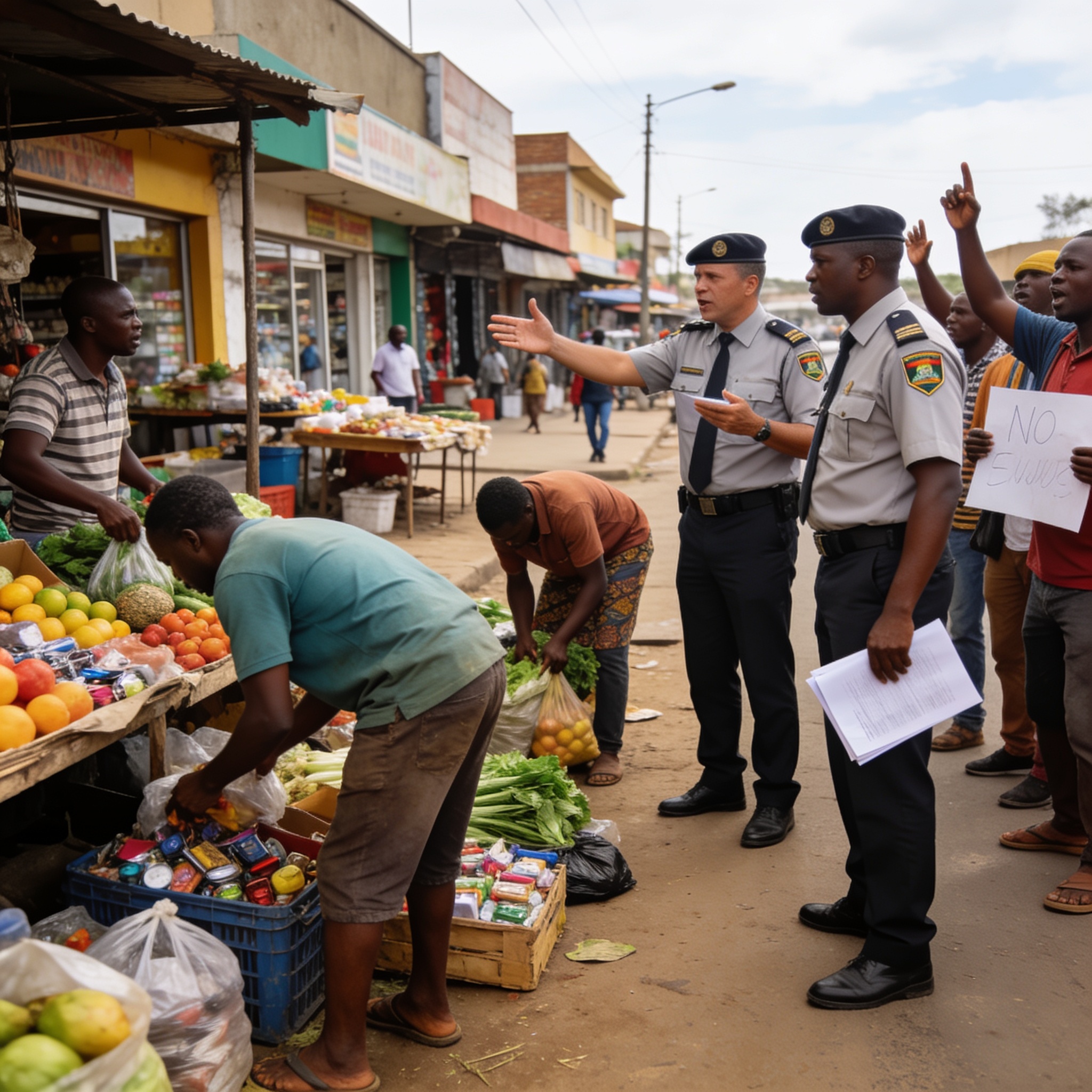
Street traders across Zimbabwe are adjusting to tighter operating rules after authorities capped vending hours in every one of the country’s 92 local authorities, a move that has ignited a fresh political row over how the state treats the country’s largest pool of self-employed workers.
Under the restrictions, which took effect immediately, vending inside central business districts is confined to the hours between 6am and 6pm. Traders operating in residential areas, including high-density suburbs, may stay open until 8pm. Councils have been directed to enforce the new timetable as part of an intensified National Cleanup Campaign targeting illegal vending and other unregulated urban activity.
Bulldozers and batons in Harare and Chitungwiza
The enforcement drive has been most visible in Harare and Chitungwiza, where municipal police, accompanied by earth-moving equipment, tore down vendor stalls and seized stock in recent days. Traders described being manhandled during the operations, and the scenes have revived a long-running argument about whether Zimbabwe is managing its cities or punishing its poorest citizens.
The government insists it has not banned vending. Officials say informal traders will continue to operate in designated zones while authorities review 113 local authority bylaws, and that the aim is to restore order in urban centres rather than to eliminate livelihoods.
Opposition says vendors were used, then discarded
The MDC’s Secretary for Information and Publicity and presidential spokesperson, Lloyd Damba, rejected that framing, describing the past week as one of the most painful for poor households in the capital and its dormitory town. He argued that the traders whose stalls were destroyed are not criminals but citizens whose only offence is trying to feed their families.
Damba traced the growth of informal trading to the collapse and downsizing of Zimbabwe’s manufacturing base, noting that many people now selling on pavements once worked as engineers, clerks and machine operators in industrial sites such as Willowvale, Graniteside, Msasa and Chitungwiza. He accused the ruling party of cultivating informal traders for electoral support, only to turn on them once the votes were counted, and warned that other groups aligned with Zanu PF could eventually face similar treatment.
He said an MDC administration would instead formalise the sector by providing serviced trading spaces, registration, concessional finance and clearly demarcated vending zones.
ZCP points to a deeper economic failure
The Zimbabwe Communist Party’s general secretary, Ngqabutho Nicholas Mabhena, made a similar diagnosis from a different ideological standpoint, arguing that street trading expanded because economic policy failed. He linked the surge in vending to the Structural Adjustment Programme of the 1990s and the retrenchments that followed, and questioned why the same group of workers previously counted as economically active is now treated as a nuisance to be cleared from city centres.
Mabhena also argued that the political calendar has shifted the government’s calculus. He pointed to the constitutional amendments signed by President Emmerson Mnangagwa on 7 July 2026, which extended presidential terms from five to seven years, replaced direct presidential elections with a parliamentary system for choosing the head of state, and pushed the next national poll beyond 2028. With elections deferred, he said, vendors are no longer seen as a constituency worth protecting.
He urged informal traders to organise within the labour movement, recalling the International Labour Organisation’s 2015 position that vendors should be represented through trade unions so they can bargain alongside the rest of the working class.
What the crackdown means for traders
For Zimbabwe’s informal sector, the practical consequences are immediate. Traders who built their daily routines around evening commuter traffic in city centres now face a hard 6pm cut-off, while those operating close to residential areas have a slightly longer window. Many are weighing whether to relocate to designated sites, absorb the cost of lost stock, or shift to unregulated locations where enforcement is weaker.
Zimbabwe’s informal economy has absorbed the bulk of workers displaced by years of deindustrialisation, and vending has become a primary source of household income for families with few alternatives. How the new operating hours are enforced — and whether affordable, serviced trading space materialises — will determine whether the policy is remembered as urban renewal or as another shock to already fragile livelihoods.
With opposition parties promising court action and continued protests, and councils under pressure to deliver order without destroying income, the vending question is likely to remain one of the most combustible issues in Zimbabwean politics in the months ahead.